Lens Choices
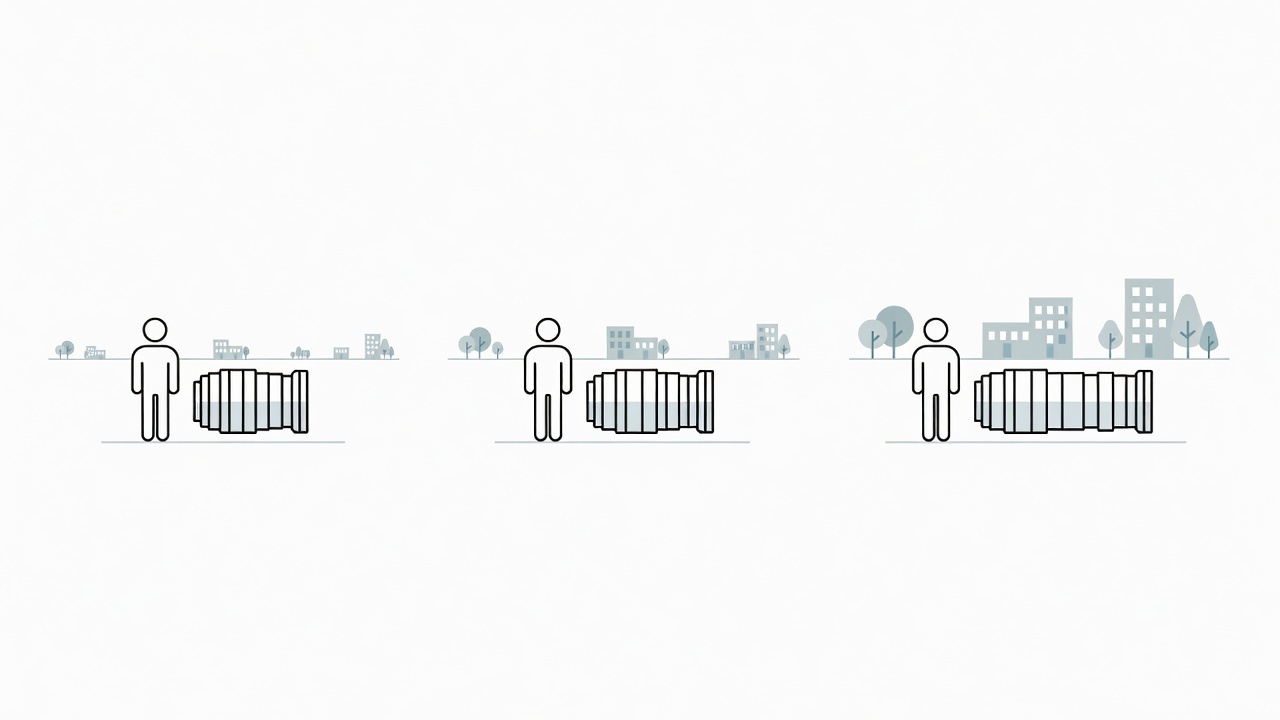
If you are constantly backing up against walls to fit your subject into the frame, you are using the wrong lens. Understanding focal lengths and aperture limits will drastically change how you shoot indoors.
1. Prime vs. Zoom Lenses Indoors
Kit lenses (like an 18-55mm zoom) are versatile but typically have variable, narrow maximum apertures (like f/3.5-5.6). This means they do not let in much light, forcing you to use slower shutter speeds (resulting in blur) or higher ISOs (resulting in noise) indoors.
A prime lens has a fixed focal length, meaning it cannot zoom. However, prime lenses usually offer much wider maximum apertures (f/1.8 or f/1.4). This allows exponentially more light into the camera, making them the superior choice for natural light indoor photography.
2. The Standard 35mm and 50mm
For most indoor environments, a 35mm or 50mm prime lens (on a full-frame sensor) is ideal.
- 35mm: Wide enough to capture the context of a room without severe distortion. Excellent for lifestyle photography, environmental portraits, and showing the space.
- 50mm: Often called the "nifty fifty." It closely mimics human field of vision. It’s perfect for half-body portraits and detailed vignettes, but it can feel slightly tight in very small rooms.
3. Handling Wide Angle Distortion
When rooms are very small, you might reach for a 24mm or even a 16mm lens. While this allows you to capture the whole room, it introduces perspective distortion. Elements near the edges of the frame will stretch and warp. If photographing a person, never put their face near the edge of a wide-angle frame.
To minimize distortion with a wide lens, keep your camera perfectly level. Pointing a wide lens up or down will cause vertical lines (like walls and doors) to severely converge or diverge.
4. Depth of Field and Aperture
Shooting at f/1.8 indoors lets in a lot of light and completely blurs the background. This is useful for hiding a messy room. However, depth of field at f/1.8 is razor-thin. If you are photographing two people side-by-side and one is slightly further back, they will be out of focus. Learn to stop down to f/2.8 or f/4 when multiple subjects are involved, adjusting your ISO to compensate.
| Focal Length (Full Frame) | Best Indoor Use Case | Distortion Risk |
|---|---|---|
| 24mm | Real estate, tight bathrooms, full room context | High on edges |
| 35mm | Lifestyle, environmental portraits, living spaces | Minimal |
| 50mm | Head-and-shoulders portraits, food, details | None |
| 85mm | Tight headshots (requires large rooms) | None |